
Some links on our site may earn us a commission at no extra cost to you. Learn more.
In the power rack vs half rack debate, the honest answer is that neither one is universally “best” — a full four-post power rack like the Rogue RML-390F wins on safety and expandability if you have a dedicated ~16-square-foot spot and 8-foot ceilings, while a wall-mounted folding rack like the PRx Performance Profile PRO is the only option of the three that gives your floor space back when you’re not lifting. A half rack, like the Titan T-3 Series, splits the difference: nearly the same capability as a full power rack for meaningfully less money. Below we compare real 2026 models on price, footprint, ceiling clearance, and weight capacity, then run the space math nobody publishes.
At a Glance
- Best overall: Rogue RML-390F Flat Foot Monster Lite Rack — four-post safety, Westside hole spacing, and a full attachment ecosystem for anyone with the floor space to spare.
- Best budget: Titan T-3 Series Half Rack — the same 11-gauge steel and 1,000 lb rating as pricier racks, for roughly $150–$330 less.
- Best for small spaces: PRx Performance Profile PRO — folds to as little as 9 inches off the wall, so a one-car garage or apartment spare room can double as something else.
Power Rack vs. Half Rack vs. Wall-Mounted Folding Rack: Compared
The table below lines up one representative, current, purchasable model from each rack category so the comparison is apples-to-apples rather than category generalities.
| Spec | Rogue RML-390F (Full Power Rack) | Titan T-3 Series (Half Rack) | PRx Profile PRO (Folding Wall-Mount) |
|---|---|---|---|
| Price | ~$935 (roguefitness.com) | ~$605–$760 (titan.fitness, price fluctuates with sales) | ~$899 base, no pull-up bar (per Garage Gym Lab) |
| Footprint (in use) | 48″ deep x 49″ wide | 47″ deep x 48″ wide base (41″x42″ walk-in) | 26.75″–39.5″ deep x 52″ wide (varies by pull-up bar) |
| Footprint (stowed) | Same — fixed, cannot fold | Same — fixed, cannot fold | 9″–22.5″ deep x 52″ wide (folds flat to wall) |
| Height | 92.375″ | 92.5″ (pull-up bar tops out at 89″) | 73″, 90″, or 96″ — buyer’s choice of upright |
| Steel / construction | 3″x3″ 11-gauge uprights, Westside hole spacing, welded, made in USA | 2″x3″ 11-gauge, Westside spacing, bolted panel joints, imported steel | 11-gauge 3″x3″ uprights, wall-stud mounted (16″ or 24″ o.c.) |
| Rated weight capacity | Up to 1,000 lb (per Garage Gym Builder’s review testing) | 1,000 lb (titan.fitness spec sheet) | 1,000 lb (prxperformance.com spec sheet) |
| Warranty | Lifetime frame warranty (roguefitness.com) | 1-year warranty; 20% restocking fee on returns (per Garage Gym Reviews) | Lifetime frame warranty (prxperformance.com) |
Full Power Rack: Rogue RML-390F Flat Foot Monster Lite Rack
The RML-390F is the decisive pick if you want one rack to outlast every future goal, from raw powerlifting to strongman accessory work. Its four-post cage, Westside hole spacing, and full Rogue attachment catalog mean the rack grows with you instead of becoming a bottleneck.
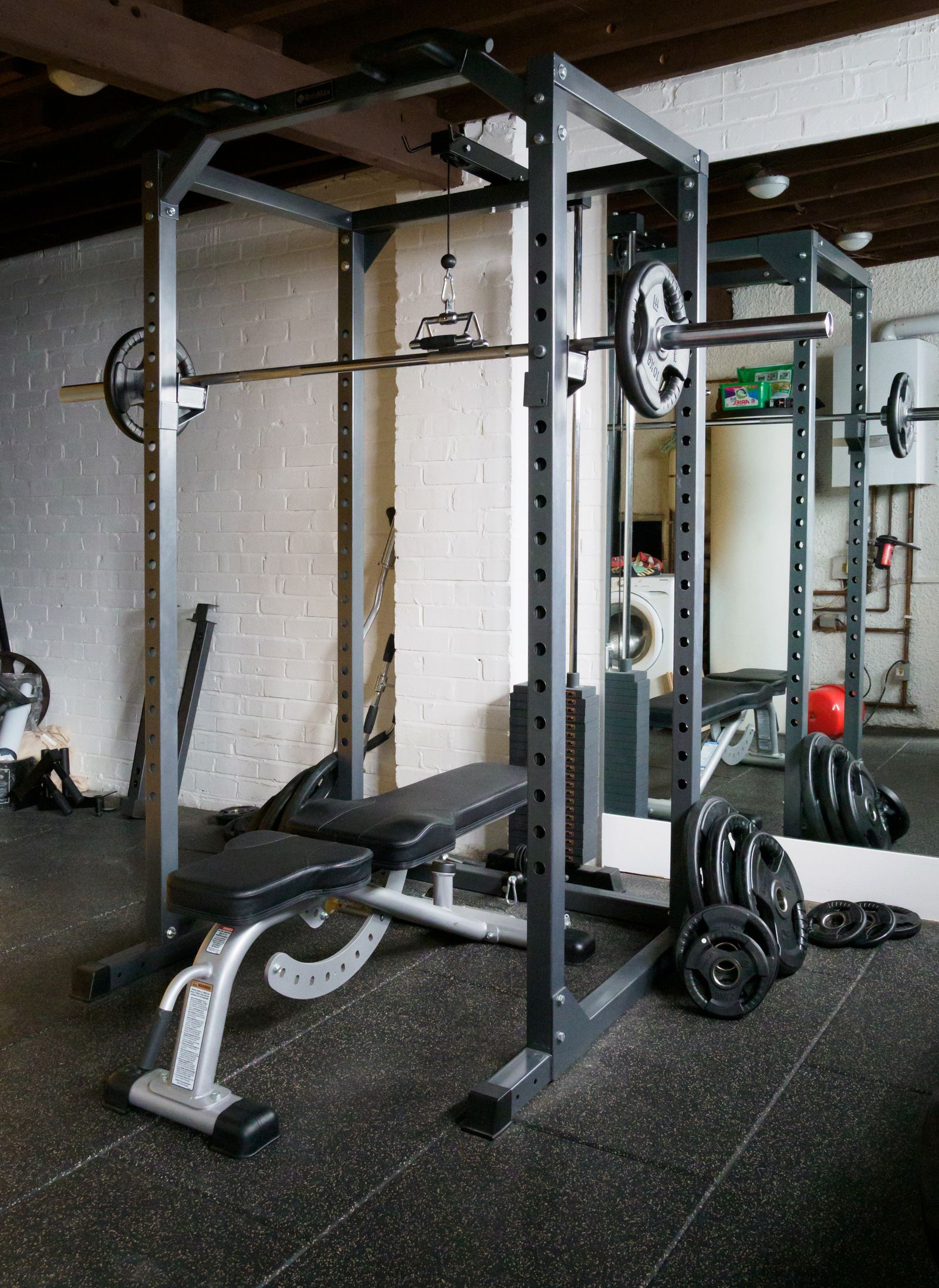
According to Rogue Fitness’s product page (roguefitness.com), the RML-390F uses 3″x3″ 11-gauge steel uprights on a flat-foot base — no bolt-down needed — and weighs 295 lbs assembled, which itself adds to stability. It ships with standard J-cups and a pin/pipe safety system, and Rogue sells pull-up bar variants, a Monster Lite strap safety system ($245), and a matching flat bench ($195) as add-ons.
The dealbreaker: at 92.375″ tall and 48″x49″ at the base, this rack needs a permanent, dedicated ~16-square-foot patch of floor and close to 8 feet of ceiling clearance. According to Garage Gym Builder’s review, the rack is “taller than most ceilings found in regular homes,” so measure before you buy — a basement with ductwork or a garage with a low header can rule this rack out entirely.
Pros
- Four-post cage design is the most stable configuration for max-effort squats and bench
- Full Rogue attachment ecosystem (safety straps, lat pulldown, dip attachments, benches)
- Welded American-made construction with a lifetime frame warranty
Cons
- Permanently consumes ~16 square feet of floor whether you’re lifting or not
- 92.375″ height rules out most basements and low-ceiling garages
- Highest sticker price of the three, before attachments
Half Rack: Titan T-3 Series Half Rack
The Titan T-3 Half Rack is the budget standout: it matches the Rogue rack’s 11-gauge steel and 1,000 lb rating for roughly $150–$330 less, per titan.fitness pricing at time of publication. For most home lifters who aren’t chasing commercial-gym certification, that’s the better value trade.
A half rack drops the rear two posts of a full cage in favor of a single rear stabilizer, which is why the T-3’s footprint (47″x48″ base) lands close to the Rogue rack’s despite being a lighter-duty design. Titan’s spec sheet lists Westside hole spacing with tighter 25mm spacing through the bench-press zone, nylon-lined J-hooks, and an adjustable pull-up bar included standard — spotter arms are sold separately.
The dealbreaker here isn’t the steel — it’s the service. According to Garage Gym Reviews’ Titan T-3 review, the rack uses “bolted panels” rather than fully welded joints, carries only a one-year warranty (“on the shorter side” for a power rack), and Titan is “known for delays and mixing up orders.” The same review calls it “incredibly similar to the Rogue rack now” on raw build quality, so the trade-off is support and long-term resale, not day-one strength.
Pros
- Same 11-gauge steel and 1,000 lb rating as pricier full racks, at a lower price
- Comes standard with a pull-up bar and J-hooks — fewer forced add-ons
- Tighter 25mm hole spacing through the bench zone for finer J-hook adjustment
Cons
- Bolted (not welded) panel joints per reviewer teardown — a weaker connection point
- Only a 1-year warranty, plus a 20% restocking fee on returns
- Same fixed, non-folding footprint as a full power rack — no space savings
Wall-Mounted Folding Rack: PRx Performance Profile PRO
If floor space is the actual constraint — not budget, not weight capacity — the PRx Profile PRO is the decisive winner. It’s the only rack of the three that can fold flat and hand the room back for a car, a yoga mat, or a kid’s bike.
Per prxperformance.com’s spec sheet, the Profile PRO uses 11-gauge 3″x3″ steel uprights rated to 1,000 lb, mounts to wall studs spaced 16″ or 24″ on center (a ledger board is required for irregular framing), and folds with no disassembly. According to Garage Gym Lab’s measurements, folded depth ranges from just 9 inches (no pull-up bar) up to 22.5 inches (kipping pull-up bar option), and it’s sold in three upright heights — 73″, 90″, or 96″ — so it’s the only rack here that can be spec’d for a low basement ceiling.
The dealbreaker: this isn’t a freestanding rack. It requires a structural wall with properly spaced studs (or a ledger board), so a garage with brick, block, or unusually framed walls may need extra carpentry before installation. It also can’t be relocated as easily as a floor-standing rack once it’s bolted in.
Pros
- Folds to as little as 9″ from the wall, reclaiming most of the room when not training
- Available in a 73″ short upright, the only option here that fits low basement ceilings
- 1,000 lb rating and lifetime frame warranty match the full power rack
Cons
- Must mount to a structural wall with correctly spaced studs — not freestanding
- Folded depth grows to 22.5″ with a kipping pull-up bar, eating into the space savings
- Highest cost-per-square-foot of usable footprint of the three (see math below)
The Space Math No Spec Sheet Prints
Every rack listing prints a footprint in inches, but none of them tell you what that footprint costs you every day it isn’t in use. We computed two original figures from the manufacturer and reviewer dimensions above: floor space reclaimed when not training, and the ceiling clearance each rack actually needs.
Floor Space Given Back When You’re Not Lifting
| Rack | In-use footprint | Stowed footprint | Space reclaimed | Price ÷ in-use sq ft |
|---|---|---|---|---|
| Rogue RML-390F | 16.33 sq ft (48″x49″) | 16.33 sq ft — fixed | 0 sq ft (0%) | $57.26/sq ft |
| Titan T-3 Half Rack | 15.67 sq ft (47″x48″) | 15.67 sq ft — fixed | 0 sq ft (0%) | $48.50/sq ft (at $760) |
| PRx Profile PRO (no bar) | 9.66 sq ft (52″x26.75″) | 3.25 sq ft (52″x9″) | 6.41 sq ft (66%) | $93.06/sq ft |
The math is blunt: the PRx costs almost double per square foot of usable training footprint, but it’s the only rack that gives 66% of that footprint back to the room the moment you fold it flat. For a one-car garage that also has to park a car, or a spare bedroom that’s also an office, that reclaimed 6.41 square feet is often worth more than the dollars-per-square-foot gap.
Ceiling Height Fit Matrix
| Rack | Structure height | Fits an 8-ft (96″) garage ceiling | Fits a 7-ft (84″) basement ceiling |
|---|---|---|---|
| Rogue RML-390F | 92.375″ | Yes, ~3.6″ of clearance | No |
| Titan T-3 Half Rack | 92.5″ (89″ pull-up bar) | Yes, ~3.5″ of clearance | No |
| PRx Profile PRO | 73″ / 90″ / 96″ (buyer’s choice) | Yes, any version | Yes — 73″ version only |
Both the Rogue and Titan racks leave under 4 inches of clearance under a standard 8-foot garage ceiling, and neither has a shorter-upright option — a low-hanging garage door opener or duct run can eliminate both instantly. The PRx is the only rack of the three sold in a 73″ upright that can realistically go into a 7-foot basement.
Whichever rack you land on, pair it with proper flooring — our home gym flooring comparison of ProsourceFit, Rubber-Cal, and FlooringInc covers what actually protects a garage slab under dropped iron. If you’re building out the rest of the setup, our adjustable dumbbell comparison of Bowflex, PowerBlock, and REP QuickDraw and our adjustable vs. flat bench vs. power tower breakdown cover the two pieces of equipment that pair most directly with any rack. You can browse every equipment guide in our home gym category.
How We Compared
We did not physically test these three racks. Our comparison is built from manufacturer spec sheets (roguefitness.com, titan.fitness, prxperformance.com), published reviewer measurements and teardown notes from outlets like Garage Gym Reviews and Garage Gym Lab, and patterns in verified owner feedback around build quality, warranty claims, and long-term reliability.
Where sources disagreed on a spec, we defaulted to the manufacturer’s own product page and noted reviewer figures separately. Full detail on how we vet sources and handle claims like this is in our editorial standards. Prices are approximate, current as of publication, and change frequently — confirm the latest price with the retailer before buying.
This comparison was compiled by the PicksWeTrust Editorial Team.
Frequently Asked Questions
What’s the difference between a power rack and a half rack?
A power rack (or full rack) has four vertical posts forming a complete cage around the lifter, while a half rack has two front posts and a single rear stabilizer bar. Both can hold similar weight ratings, but the four-post design is generally considered more stable for max-effort lifts.
Is a half rack safe for heavy squats and bench press?
Yes — a half rack like the Titan T-3, rated to 1,000 lb per titan.fitness, is built from the same 11-gauge steel class as many full power racks. It’s a legitimate choice for heavy squats and bench, though it lacks the rear safety cage some lifters prefer for unassisted max attempts.
Do I need a power rack or will a folding wall-mounted rack work?
A folding wall-mounted rack like the PRx Profile PRO works for most home lifters and is the better choice if floor space is genuinely limited, since it reclaims up to 66% of its footprint when folded. A fixed power rack makes more sense if you have dedicated space and want the widest range of attachments.
How much ceiling height do I need for a squat rack?
Most full power racks and half racks stand around 92–93 inches tall, so an 8-foot (96″) ceiling leaves only 3–4 inches of clearance. A wall-mounted folding rack like the PRx Profile PRO is sold in a shorter 73″ upright option that can fit basements with as little as 7-foot ceilings.
Can a wall-mounted folding rack hold as much weight as a power rack?
Yes, on paper — the PRx Profile PRO carries the same 1,000 lb rating as the Rogue RML-390F power rack, according to both manufacturers’ spec sheets. The difference is stability under the heaviest unassisted lifts and installation: the folding rack depends entirely on a properly framed wall for that rating.
