Some links on our site may earn us a commission at no extra cost to you. Learn more.
Every beach town has the same recurring afternoon spectacle: a gust arrives, and somewhere down the sand an umbrella tears loose and cartwheels toward the water while its owners give chase. Beach shade looks like the simplest purchase in the outdoor aisle, and it is quietly one of the most failure-prone. The classic umbrella is cheap and fast but famously flighty. The pop-up canopy shades a whole family and doubles as backyard equipment, but in wind it behaves like a box kite with legs. And the newer wind-sail shades — stretchy fabric flown from poles and sandbag anchors — were designed around the exact conditions that destroy the other two, at the cost of a learning curve.
The right choice comes down to an honest question: what does your typical afternoon actually look like? A calm lake beach, a gusty ocean shore, and a backyard birthday party are three different problems wearing the same “shade” label.
Quick answer: on a genuinely breezy beach, the wind-sail shade is the design most likely to still be standing at 4 p.m.; the umbrella wins for solo simplicity and calm days, and the canopy wins everywhere the ground takes stakes and the crowd is big.
Our verdict at a glance
- Best overall: Wind-sail shade — engineered for the breeze that defeats everything else, with generous coverage and featherweight packing
- Best budget: Beach umbrella with a sand anchor — minimal cost, minimal bulk, entirely adequate on calm days
- Best upgrade: A quality pop-up canopy — the most shade, the most versatility, and the natural pick for family basecamps and backyards
- Best for backyards and parks: Canopy — on grass with proper stakes, its wind problem largely disappears
How the three shade styles compare
| Attribute | Beach umbrella | Pop-up canopy | Wind-sail shade |
|---|---|---|---|
| Price tier | $ | $$–$$$ | $$ |
| Behavior in gusty wind | Poor — the classic runaway | Poor to fair — catches gusts like a sail box | Best — flexes and spills wind by design |
| Shade area | Small — 2–3 people | Largest — family and gear | Large — several people, moves with the sun |
| Setup effort | Easiest solo | Hardest — really a two-person job | Moderate — easy after the first few tries |
| Packed weight and bulk | Light, slim | Heavy, awkward to carry far | Lightest per square foot of shade |
| Versatility beyond sand | Fair — needs somewhere to plant the pole | Best — backyard, tailgate, market stall | Limited — needs sand or soft ground for anchors |
The beach umbrella: cheap, fast, and flighty
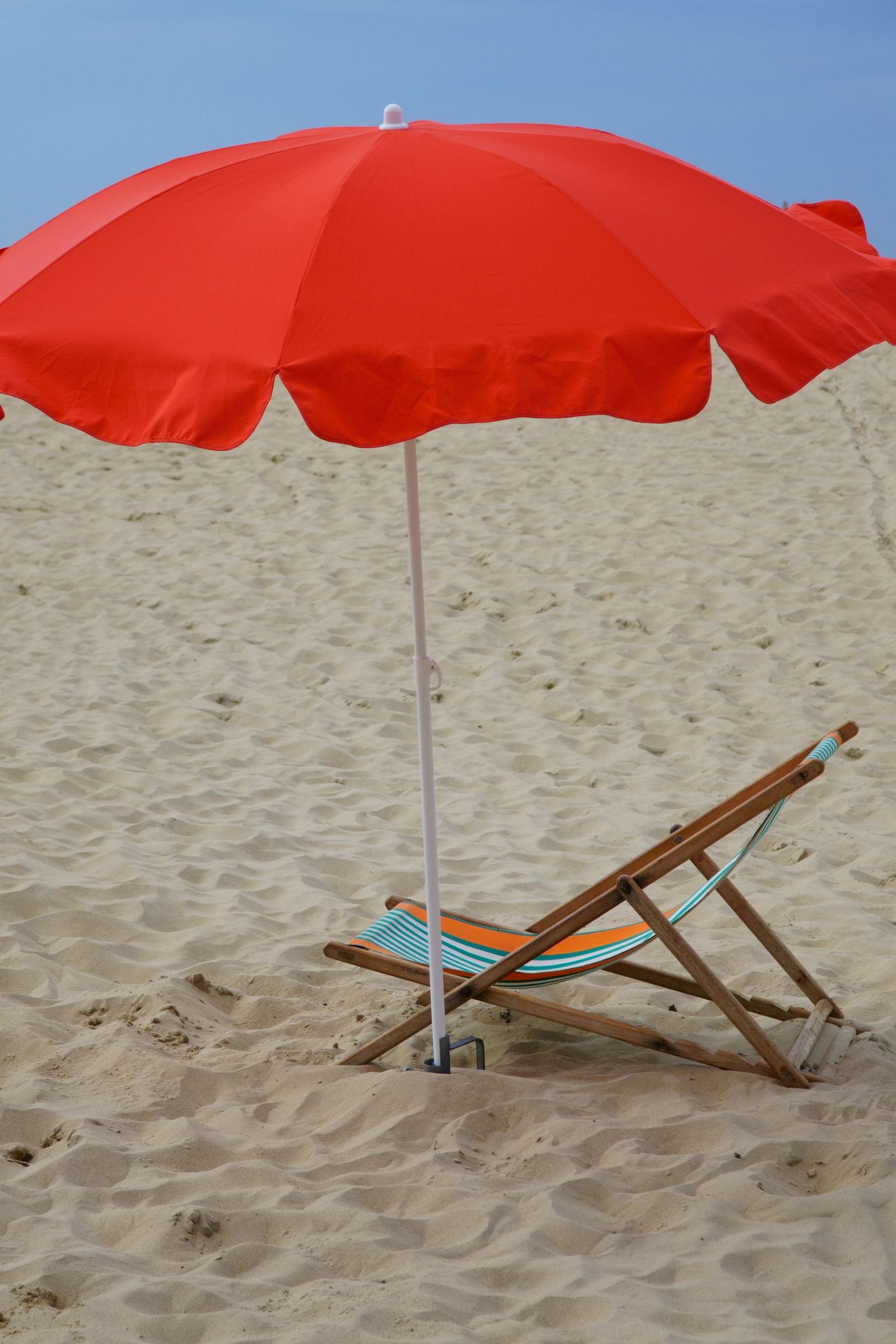
Where it wins. Simplicity is the umbrella’s whole argument, and it’s a good one. It costs the least, packs into a slim sleeve that slings over a shoulder alongside a chair, and goes from car to shade in a couple of minutes with one pair of hands. Tilting the head keeps shade where you want it as the sun moves, and on a calm morning it does everything the fancier options do. Modern refinements help more than they sound like they would: a screw-in sand auger instead of a plain spike, a vented double canopy that lets pressure escape, and a lower profile all make the difference between an umbrella that stays and one that flies.
Honest drawbacks. Wind is the obvious one — a canopy on a single high pole is a lever begging to be pulled, and the most common umbrella story owners tell involves a sprint down the beach. Even properly anchored, gusts invert cheap ribs and work augers loose as sand dries. The shade footprint is honestly small: two adults, maybe a toddler, and by afternoon you’re shuffling chairs every half hour to follow the shadow. A loose umbrella is also the one shade failure that can genuinely hurt bystanders, which is why anchoring isn’t optional.
Who should buy it. Solo beachgoers, couples, and anyone whose beach days are short, spontaneous, and mostly calm. Buy the sand auger with it and bury the base generously — technique is half the product.
Who should skip it. Anyone on a shore where the afternoon sea breeze is a daily appointment, and families who need real coverage. Both are better served below.
The pop-up canopy: maximum shade, maximum sail
Where it wins. Nothing else here creates a basecamp. A canopy throws a large square of deep shade big enough for the whole family, the cooler, the toys, and a folding table — and it earns its keep off the sand too, covering birthday parties, tailgates, and campsite kitchens. The accordion frame needs no assembly, just extension, and the shade doesn’t migrate as the sun moves the way an umbrella’s does. If your beach day involves more than four people or your “beach gear” also works weekends in the backyard, the canopy’s versatility is unmatched, which is exactly why it pairs so naturally with the family-scale gear in our cooler comparison.
Honest drawbacks. On a breezy beach the canopy is the most dramatic failure of the three. That big flat roof catches gusts from every direction, the straight legs give wind a frame to lift, and soft sand offers its stakes very little to hold. Owners consistently report bent frames as the first casualty — a leg buckles in a gust and never telescopes smoothly again. Weight guards against this: proper sandbags on every leg, guylines out at angles, and the roof vented or lowered. But that means hauling the heaviest, most awkward package on this list plus the anchor weight across soft sand, and setup is honestly a two-person job. On grass with real stakes, most of these problems fade; on sand they define the experience.
Who should buy it. Families running an all-day basecamp near the car, hosts who’ll use it in the backyard a dozen times a year, and anyone at parks, fields, or campgrounds where stakes bite. As an upgrade for people who need shade at scale, it’s the clear pick.
Who should skip it. Anyone carrying gear a long way down soft sand, and anyone on a reliably gusty shore who won’t commit to sandbagging every leg every time. An unanchored canopy on a windy beach is a matter of when, not if.
The wind-sail shade: designed for the breeze
Where it wins. The wind-sail flips the problem: instead of fighting the breeze with rigidity, it uses it. A stretchy canopy flown between lightweight poles and sand-filled anchor pockets flexes with each gust and spills the pressure through, so the same afternoon breeze that launches umbrellas simply makes the sail ripple. Set up properly, it’s the design most likely to survive a breezy afternoon intact — which is the entire premise of this comparison. The bonuses are real too: shade coverage rivals a small canopy at a fraction of the weight, the whole kit packs down to a bundle one person carries easily, and the open sides keep air moving underneath rather than trapping heat the way enclosed canopies can.
Honest drawbacks. It has a learning curve, and the first setup in a stiff breeze can be humbling — orientation relative to the wind matters, and the anchors want a genuinely generous fill of sand. Counterintuitively, its weakest condition is dead calm: with no breeze to tension the canopy, some designs sag until you reposition the poles. Shade also shifts as the sun moves, the open design offers no rain protection worth mentioning, and off the beach it’s nearly useless — the anchoring system needs sand or soft ground, so it won’t serve backyard duty. It is a specialist, brilliant inside its specialty.
Who should buy it. Regular beachgoers on breezy coasts, walk-on beach visitors who carry everything, and families who want big shade without hauling a frame. If your beach has a daily sea breeze, this is the one to own — and our best overall.
Who should skip it. Buyers who need one shade for beach, backyard, and tailgate — that’s canopy territory — and anyone who wants zero-thought setup on calm lake days, where the humble umbrella remains hard to beat.
How we compared
We compared the three shade architectures on the factors that decide whether a beach afternoon ends well: behavior in gusty onshore wind, usable shade area, one-person setup practicality, carry weight and bulk over soft sand, versatility beyond the beach, and price tier rather than exact prices, which vary widely by size and season. Because shade failures are overwhelmingly about design and anchoring rather than brand, we evaluated categories rather than individual models, and we weighted the failure patterns owners consistently report — runaway umbrellas, bent canopy frames, sagging sails in calm — over marketing claims. You’ll find our other head-to-heads in the Outdoors & Travel category.
Frequently asked questions
How windy is too windy for a beach umbrella?
There’s no universal number, but a useful test is the flag test: if flags are standing straight out and sand is skimming along the surface, a single-pole umbrella is living on borrowed time no matter how well it’s anchored. In those conditions, tilt it low into the wind, or better, take it down — a folded umbrella never hurt anyone.
Do sand anchors actually work?
Yes — a screw-in auger or a buried anchor bag dramatically improves an umbrella’s hold, and owners consistently report they’re the difference between staying and chasing. The caveat is technique: the auger needs to reach damp, compacted sand, and the pole should lean slightly into the wind. An anchor used casually is barely an anchor.
Can I use a pop-up canopy on the beach at all?
Absolutely, with commitment: a filled sandbag on every leg, guylines staked deep at angles, and a spot with some natural shelter if you can find one. Calm-morning beach days with a canopy are wonderful. The mistake is treating sand like grass and wind like a maybe.
Do shade products really block UV?
Quality shade fabric carries a UPF rating, and higher is better — but remember that sand and water reflect UV up underneath any shade, so you can still burn while sitting in it. Treat shade as a supplement to sunscreen, not a substitute, especially for kids parked under it all day.
Which shade is easiest to set up alone?
The umbrella, by a comfortable margin — one person, two minutes, no instructions. A wind-sail is a solid solo job once you’ve done it twice. A full-size canopy is genuinely difficult alone; the frame wants a person on each end, which is worth knowing before you’re the only adult on the trip.
Bottom line
Ask what your afternoon usually does. If it stays calm and your party is small, the umbrella-plus-anchor remains the best few dollars in beach gear. If your shade also needs to work birthdays and tailgates — or your crew rolls deep with coolers and chairs — the canopy earns its bulk, on the strict condition that you anchor it like you mean it. But on the breezy ocean beach that this comparison is really about, the wind-sail shade is the design that treats wind as an ingredient instead of an enemy, and it’s the one we’d carry down the sand. Sorting out the rest of the summer kit? Our tent comparison and carry-on face-off apply the same match-the-gear-to-the-user logic.