Note: We are not veterinarians, and this comparison is not pet-care advice. Wheel sizing matters for animal welfare — confirm the right size for your species and individual pet. Affiliate disclosure: some links may earn us a commission at no extra cost to you — commissions never influence a ranking.
A hamster can run several miles a night, and the wheel is where most of it happens — making it the single most-used piece of equipment in the enclosure and the one the starter-cage industry most reliably gets wrong. Three designs compete: the classic upright wheel, the flying-saucer style disc, and the wire wheel that welfare guidance keeps trying to retire. Here’s the face-off.
The contenders
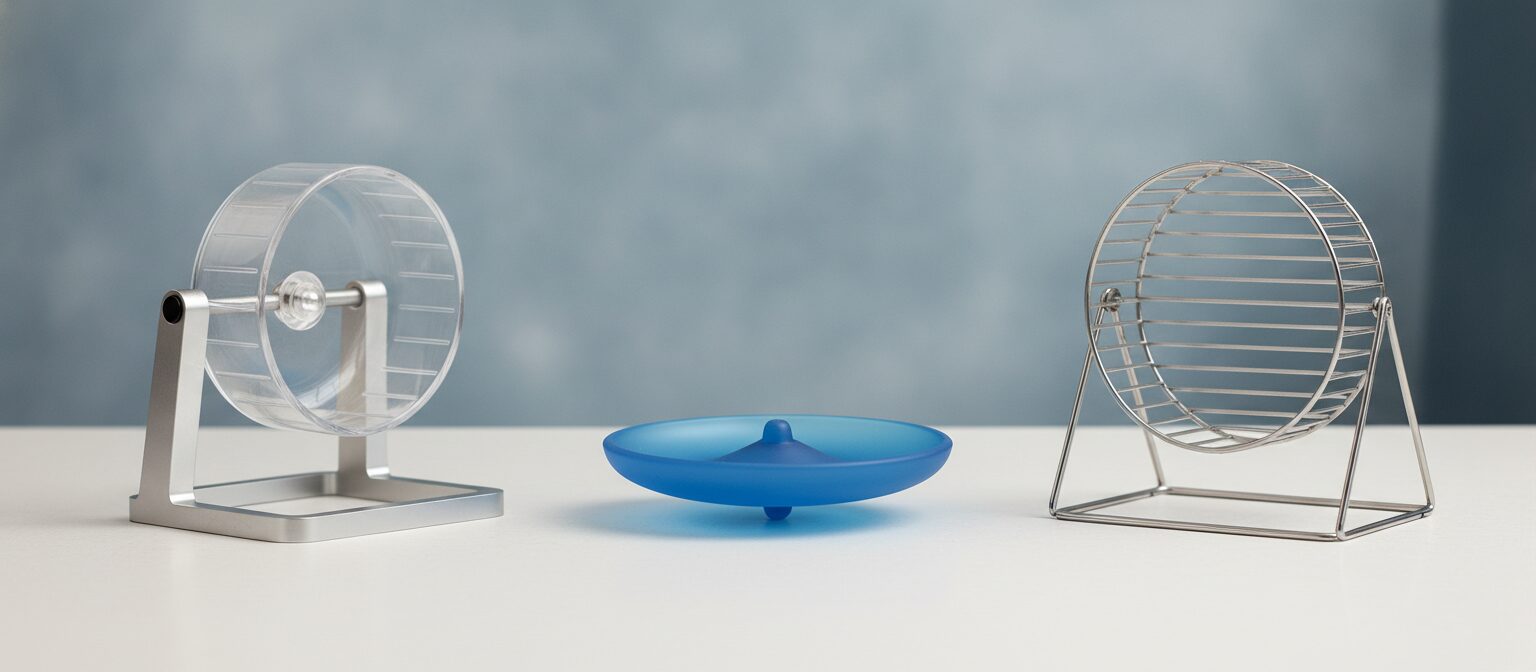
Solid upright wheels — the modern standard: a solid running surface, closed back, on a stand or clip.
Flying saucers — angled solid discs the animal runs on top of; a favorite with pets who dislike enclosed wheels.
Wire/rung wheels — the old-school design with spaced bars, still bundled with cheap cages.
Round 1: Safety
This round retires a category. Wire wheels’ spaced rungs catch feet and legs — bumblefoot and limb injuries associated with rung and mesh surfaces are why modern welfare guidance and virtually every enthusiast community recommend solid surfaces only. Uprights and saucers both pass; between them, saucers’ open design eliminates any back-guard pinch points, while quality uprights are equally safe when sized correctly.
Winner: Solid designs, full stop. Wire wheels shouldn’t be sold with hamsters, and they finish this face-off here.
Round 2: The size rule that decides everything
The most repeated advice in hamster reviews: the wheel must be big enough that the animal runs with a flat back — a curved spine mid-run means the wheel is too small, whatever the packaging says. In practice that means much larger than starter-cage wheels: roughly 8–9 inches minimum for dwarf species and 10–12 inches for Syrians, per the sizes the enthusiast community has converged on. Uprights win here on footprint: a 12-inch saucer needs a huge flat area, while a 12-inch upright needs height. Both come in proper sizes; the difference is what your enclosure can fit.

Winner: Upright, on space-efficiency at correct sizes.
Round 3: Noise (the 3 a.m. round)
Hamsters are nocturnal; you are not. Cheap uprights squeak and clatter — the top complaint in the category — while premium uprights with sealed ball bearings earn cult followings for near-silence. Saucers are naturally quiet (nothing rattles) but produce a rhythmic scrabble as feet grip the angled surface, and enthusiastic runners can drift them into cage walls. Owner consensus: bearing quality matters more than design.
Winner: Draw — buy the bearings, not the shape.
Round 4: The running itself
A subtle round from long-term owners: some pets simply prefer one style. Saucers suit animals that dislike enclosure and the odd individual who never took to a wheel at all; the angled running posture, however, is less natural over long sessions, which is why many keepers offer a saucer alongside a proper upright rather than instead of it. Uprights deliver the straight-line gait closest to natural running.
Winner: Upright, with the saucer as the great second opinion.
The verdict
- Best overall: A large, solid-surface upright with quality bearings — flat-back sized (10–12″ for Syrians, 8–9″+ for dwarfs), silent, and space-efficient.
- Best supplement or picky-runner pick: A flying saucer — quiet, pinch-free, and beloved by wheel-skeptical pets, if your enclosure has the floor space.
- Buy never: Wire and mesh wheels — the one unambiguous answer in this face-off.
One more sizing reality: a properly sized wheel often doesn’t fit the cage it came with — which is the wheel telling you something about the cage. Our small pet housing face-off covers the upgrade.