Some links on our site may earn us a commission at no extra cost to you. Learn more.
Home cardio equipment has a dirty secret: most of it becomes furniture. The machine that seemed like a commitment device in January is a coat rack by March, and in a small apartment it is a coat rack you trip over. That is the real stakes of this decision. If you have one corner of a living room, a slice of a home office, or a strip of floor beside the couch, choosing between a walking pad, a folding treadmill, and an exercise bike is less about specs and more about which machine you will genuinely use four times a week in the space you actually have.
The three machines make very different bargains. A walking pad is the smallest and quietest but caps your intensity at a brisk walk or gentle jog. A treadmill covers everything from strolling to sprinting but demands the most floor space, ceiling clearance, and tolerance for noise. An exercise bike splits the difference: a small, fixed footprint and near-silent operation, with real intensity available, at the cost of working fewer muscle groups and being a workout you must decide to do rather than one you can fold into your day.
Quick answer: for most small-space dwellers who mainly want more daily movement, a walking pad is the best pick; choose an exercise bike if you want genuinely hard workouts in the smallest permanent footprint, and choose a compact treadmill only if running specifically is the goal and you have the room for it.
Our verdict at a glance
- Best overall for small spaces: Walking pad — slides under a couch or bed, near-silent, and low-friction enough that you actually use it daily.
- Best budget: Walking pad again — entry-level pads sit in the lowest price tier of the three categories.
- Best upgrade: A quality exercise bike — the most training capability per square foot, and the machine most likely to survive years of hard use.
- Best for runners: A folding treadmill — nothing else lets you actually run, but budget for the space and noise it brings.
- Best for desk workers: Walking pad under a standing desk — the only option here that turns work hours into movement hours.
How the three compare
| Attribute | Walking pad | Folding treadmill | Exercise bike |
|---|---|---|---|
| Footprint in use | Smallest | Largest | Small and fixed |
| Storability | Excellent — slides under furniture | Fair — folds upright but stays bulky | Poor — it lives where it lives |
| Workout intensity ceiling | Low — walking to light jogging | High — up to full running | High — sprints and hard intervals |
| Noise level | Low | Moderate to high, plus footfall | Very low |
| Joint impact | Low | Moderate | Very low |
| Price tier | $ | $$–$$$ | $–$$$ |
Notice that intensity ceiling and footprint pull in opposite directions across the whole table. The machine that disappears most completely from your home also disappears most completely as a training stimulus, and the machine that can genuinely replace a gym cardio session is the one you cannot hide. There is no free lunch here — only the right trade-off for your goals.
Walking pad: the consistency machine
Where it wins. The walking pad’s superpower is that it removes every excuse. It weighs little enough to reposition alone, slides under a bed or sofa when you are done, and runs quietly enough for apartments with downstairs neighbors and shared walls. Paired with a standing desk, it converts email hours into thousands of steps without carving a dedicated workout out of your day. Owners consistently report that their total daily movement rises dramatically simply because the pad is always thirty seconds from usable — the friction of starting is almost zero, and in home fitness, friction is what kills habits.
Honest drawbacks. A walking pad is not a treadmill in disguise. Most have no incline, modest top speeds, and small motors tuned for walking pace, so the intensity ceiling is genuinely low — you will not train for a fast race on one. The compact decks are shorter and narrower than treadmill belts, which taller users notice immediately. The most common complaint from owners involves belt maintenance: compact belts need occasional lubrication and re-centering, and neglect shows up faster than on a full-size machine. Cheap pads can also feel flimsy underfoot at anything above a stroll.
Who should buy it. Desk workers, people whose main goal is more daily movement rather than formal cardio sessions, apartment dwellers with noise constraints, and anyone who has previously abandoned a bigger machine and wants the lowest-friction restart possible.
Who should skip it. Runners, high-intensity interval fans, and anyone who wants one machine to deliver hard training sessions — a pad supplements a fitness routine; it rarely is one.
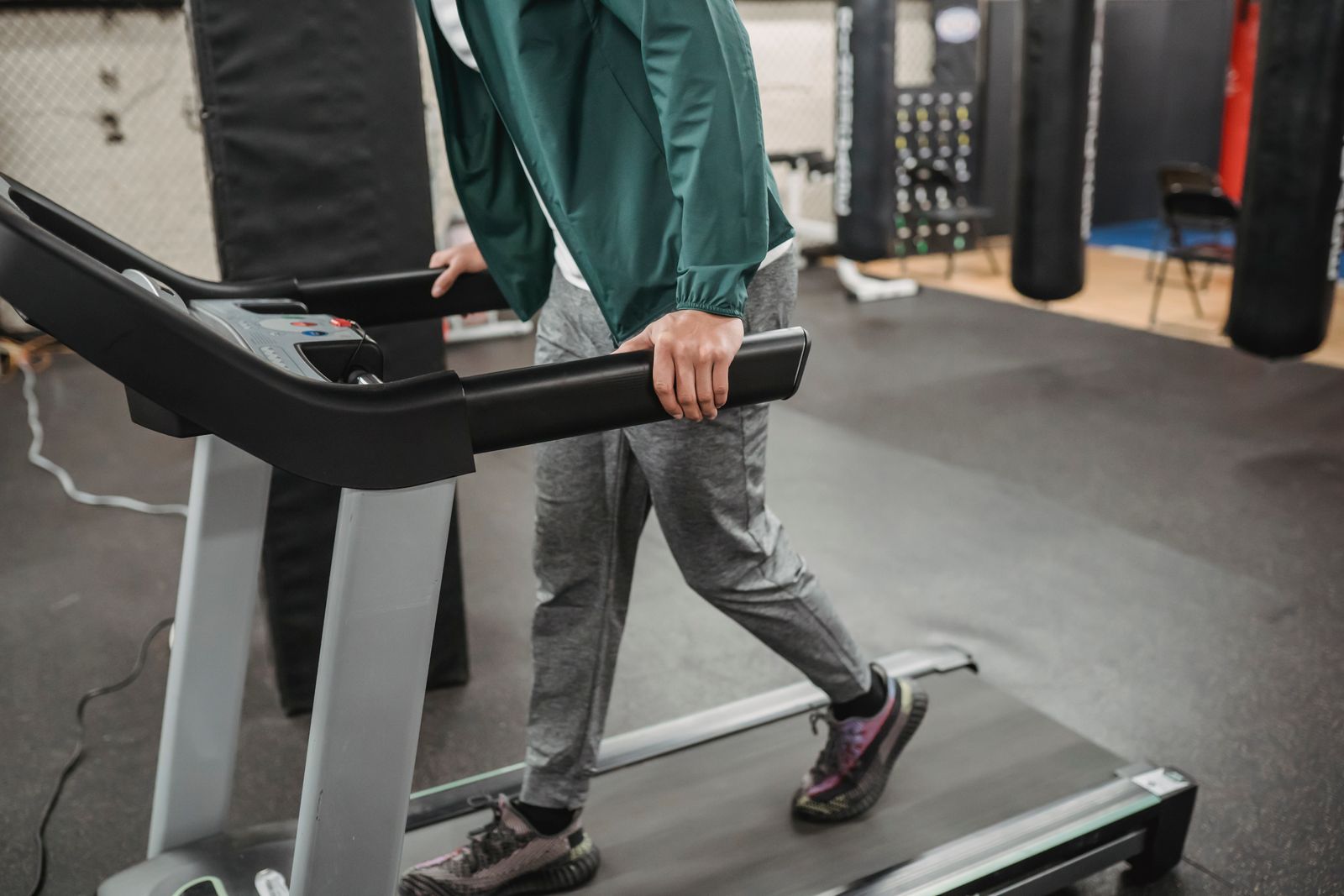
Folding treadmill: the full-range option
Where it wins. Nothing else in this comparison lets you run. A proper folding treadmill offers real speed range, incline for hill work, a longer and wider belt, and a motor built for sustained effort — meaning a single machine covers everything from recovery walks to tempo runs to sprint intervals. For runners facing dark winters, unsafe streets, or brutal summers, that capability is the whole ballgame. Modern folding frames are also far better than their reputation: they fold upright to reclaim floor space between sessions, and mid-tier models are stable enough for genuinely hard running.
Honest drawbacks. Even folded, a treadmill is a large object that dominates a small room, and in use it needs clearance behind the belt for safety plus ceiling height for taller runners at incline. Noise is the other tax: motor hum plus footfall carries through floors, which makes running in an upstairs apartment a neighborly diplomacy problem. Folding mechanisms and deck cushioning are also long-term wear points — the most common complaint from owners of budget folders is a deck that develops squeaks and a fold assist that weakens with age. Cheap treadmills are the worst value in home fitness; if you cannot budget for the middle tier, one of the other two machines will serve you better.
Who should buy it. Runners first and foremost, families where multiple people will use one machine across a wide range of paces, and anyone whose training plan genuinely requires speed and incline variety.
Who should skip it. Anyone with strict noise constraints or genuinely tiny floor plans, walkers who would pay a large space-and-money premium for capability they will not use, and buyers tempted by the very cheapest folding models.
Exercise bike: the quiet workhorse
Where it wins. The exercise bike offers the most workout per square foot of anything here. Its footprint is barely larger than an office chair, it never needs the storage dance because there is nothing to fold, and magnetic-resistance models are so quiet you can train hard next to a sleeping baby or during a conference call. The intensity ceiling is genuinely high — interval sessions on a bike are as demanding as you care to make them — while joint impact stays near zero, which matters for heavier riders, older exercisers, and anyone managing cranky knees. Mechanically, bikes are the simplest machines in this comparison, and owners consistently report them running for years with almost no maintenance.
Honest drawbacks. A bike only trains what a bike trains: it is lower-body dominant, burns nothing into your walking or running mechanics, and does not add daily background movement the way a walking pad does — every session is a deliberate decision to sit down and suffer. Saddle discomfort is the most common complaint from new owners, and while it usually fades within a couple of weeks, it is a genuine adoption hurdle. Budget bikes also cut corners on adjustability, and a bike that cannot fit your body properly is a bike you will quietly stop riding.
Who should buy it. People who want real, hard cardio in a small permanent footprint, anyone needing zero-impact training, night-owl or early-bird exercisers with thin walls, and structured-workout fans who like interval sessions.
Who should skip it. Anyone whose goal is step count and ambient daily movement, runners in training, and people who already know from gym experience that they find stationary cycling unbearably dull — no purchase price fixes boredom.
How we compared
We compared the three categories on the attributes that decide whether home cardio equipment gets used or abandoned: in-use footprint and storability, workout intensity ceiling, noise, joint impact, maintenance burden, and relative cost. We weight consistency-friendliness heavily — a technically superior machine that intimidates you into avoidance is a worse buy than a modest one you use daily — and we summarize consistent patterns in long-term owner feedback rather than citing single reviews or exact prices, which shift constantly. This piece follows the same approach as the rest of our health and fitness comparisons, including our companion guide to adjustable dumbbells for home strength training.
Frequently asked questions
Can a walking pad replace a treadmill?
Only if your goals live at walking pace. For step count, active desk time, and easy recovery movement, a pad does the job in a fraction of the space. For running, incline work, or any workout meant to leave you breathless, it cannot — the motor, deck length, and speed range are not built for it.
Which machine is quietest for an apartment?
The exercise bike, and it is not close. Magnetic resistance is nearly silent and there is no footfall to travel through the floor. A walking pad is a reasonable second. A treadmill is the riskiest choice for shared buildings because impact noise transmits even when the motor is quiet.
Which burns the most calories?
The machine you use hardest and most often. A treadmill run or a hard bike interval session outpaces walking minute for minute, but a walking pad used two hours a day can quietly out-total a bike used twice a week. Buy for the behavior you will sustain, not the theoretical maximum.
Are cheap folding treadmills worth it?
Usually not. The lowest tier of folding treadmills is where the category’s worst reliability stories live — underpowered motors, short belts, and wobbly decks. If your budget only reaches that tier, a walking pad or a simple bike delivers a better machine for the same money.
Should I pair cardio equipment with strength training?
Ideally, yes — cardio and strength complement each other, and a compact setup handles both. A pair of adjustable dumbbells covers the strength side in about two square feet; our Bowflex vs PowerBlock vs NordicTrack comparison breaks down the options. And when the training volume climbs, our massage gun vs foam roller guide covers the recovery side.
Bottom line
Match the machine to the behavior, not the fantasy. If your honest goal is to move more every day in a small home, buy the walking pad — it wins on price tier, footprint, and the consistency that actually drives results. If you want hard, structured cardio in the smallest permanent footprint and the quietest package, the exercise bike is the strongest all-around machine and the best upgrade pick. And if you are a runner, stop trying to talk yourself out of it: only the treadmill runs, so give it the space and the mid-tier budget it needs. Any of the three beats the machine that looked impressive and became a coat rack.